
Manufacturer Good Price Stearic acid CAS:57-11-4

Synonyms
ACIDUM STEARICUM 50;CETYLACETIC ACID;FEMA 3035;CARBOXYLIC ACID C18;C18;C18:0 FATTY ACID;hystrene5016;hystrene7018
Applications of Stearic acid
Stearic acid, (industrial grade) Stearic acid is one of several major long-chain fatty acids comprising oils and fats. It is presented in animal fats, oil and some kinds of vegetable oils as wellin the form of glycerides. These oils, after hydrolysis, produce the stearic acid.
Stearic acid is a fatty acid widely existing in nature and has the general chemical properties of carboxylic acids. Almost all kinds of fat and oil contain certain amount of stearic acid with the content in the animal fats being relative high. For example, the content in the butter can reach up to 24% while the content in vegetable oil is relative low with the value in tea oil being 0.8% and the oil in palm being 6%. However, the content in cocoa can reach as high as 34%.
There are two major approaches for industrial production of stearic acid, namely fractionation and compression method. Add decomposition agent to the hydrogenated oil, and then hydrolyze to give the crude fatty acid, further go through washing with water, distillation, bleaching to obtain the finished products with glycerol as the byproduct.
Most domestic manufacturers use animal fat for production. Some kinds of production technology will result in the incompletion of the distillation of fatty acid which produce stimulating odor at the time of the plastic processing and high temperatures. Although these odor is of no toxic but they will have certain effect on the working conditions and the natural environment. Most imported form of stearic acid takes vegetable oil as the raw materials, the production processes are more advanced; the produced stearic acid is of stable performance, good lubrication property and less odor in the application.
Stearic acid is mainly used for the production of stearates such as sodium stearate, magnesium stearate, calcium stearate, lead stearate, aluminum stearate, cadmium stearate, iron stearate, and potassium stearate. The sodium or potassium salt of stearic acid is the component of soap. Although sodium stearate has a less decontamination ability than sodium palmitate, but its presence may increase the hardness of soap.
Take butter as raw material, go through sulfuric acid or pressurized method for decomposition. The free fatty acids was first subject to water pressure method for removing the palmitic acid and oleic acid at 30~40 ℃, and then dissolved in ethanol, followed by addition of barium acetate or magnesium acetate which precipitates stearate. Then further add dilute sulfuric acid to get the free stearate acid, filter and take it, and re-crystallize in ethanol to obtain the pure stearic acid.



Specification of Stearic acid
|
ITEM |
|
|
Iodine value |
≤8 |
|
Acid value |
192-218 |
|
Saponification value |
193-220 |
|
Color |
≤400 |
|
Melting Point,℃ |
≥52 |
|
Moisture |
≤0.1 |
Packing of Stearic acid


25kg/bag Stearic acid
Storage should be at cool, dry and ventilate.
FAQ
Q1: What is stearic
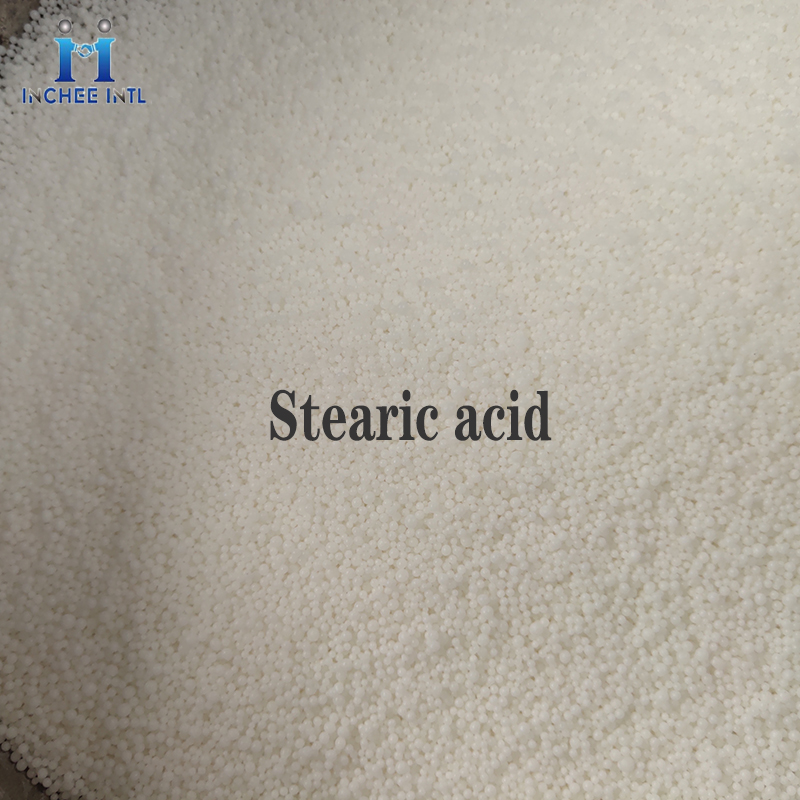
Stearic acid, chemically known as octadecanoic acid, is a saturated higher fatty acid refined from the hydrolysis and hydrogenation of natural animal and vegetable oils. It is a fundamental and widely used powdery raw material in the chemical industry. At room temperature, it appears as odorless, fine white or slightly yellow waxy solids, flakes or granules. Core physical and chemical properties: It features extremely stable chemical performance with no double bond structure, delivering excellent oxidation resistance, acid and alkali resistance, and high-temperature stability, and is far less prone to oxidation and rancidity than oleic acid. It is insoluble in water but soluble in ethanol, ether, grease and other organic solvents. It possesses outstanding lubricity, emulsification, dispersibility, mold release performance, plasticizing property and waterproof performance. With a fixed melting point, it melts into a clear oily liquid when heated and solidifies again after cooling, showing strong adaptability to various processing technologies.
Q2: What are the CAS number, molecular formula, core parameters and executive standards of stearic acid?
CAS Number: 57-11-4; Molecular Formula: C₁₈H₃₆O₂; Molecular Weight: 284.48; Melting Point: 54–57℃; Acid Value: 205–210mg/g; Iodine Value: ≤2.0g/100g (ultra-low iodine value with high saturation purity). The mainstream domestic standard is GB/T 9103-2013 Industrial Stearic Acid. Industrial stearic acid is generally divided into first-grade, second-grade and refined grades. Core testing indicators include acid value, iodine value, solidifying point, color, moisture and ash content. It is a compliant universal raw material widely used in rubber and plastic, daily chemical, coating and auxiliary industries.
Q3: What are the core differences between stearic acid and oleic acid? How to choose the right one?
Although both belong to fatty acids, they differ greatly in molecular structure and application performance and cannot be substituted for each other: 1. Structural difference: Stearic acid is a saturated fatty acid with no double bonds, featuring ultra-stable properties and strong resistance to oxidation and rancidity; oleic acid is an unsaturated fatty acid that is easy to oxidize, discolor and deteriorate. 2. Morphological difference: Stearic acid exists as white solid flakes or particles at room temperature, while oleic acid is a pale yellow liquid. 3. Performance difference: Stearic acid has better lubrication, mold release, plasticizing and waterproof effects with excellent high-temperature and storage stability; oleic acid shows superior emulsification, wetting and penetrating performance. 4. Selection suggestion: Choose stearic acid for scenarios requiring high stability, high temperature resistance, mold release lubrication and long-term storage; choose oleic acid for systems that need emulsification, wetting, penetration and low-temperature processing.
Q4: What grades does industrial stearic acid have? What are the applicable scenarios for each grade?
Industrial stearic acid is mainly classified into three grades. Higher grades have fewer impurities, whiter color and better stability: 1. Second-grade stearic acid: Slightly yellow in color with high cost performance, suitable for low-end rubber products, ordinary lubricants, low-end coatings, waterproof coils and general industrial auxiliaries. 2. First-grade stearic acid: Features good whiteness, low impurities and stable indicators, applicable to rubber and plastic processing, shoe sole materials, ordinary daily chemicals, candles, soap and coating dispersants. 3. High-purity refined first-grade stearic acid: Pure white, odorless, low in ash content and high in stability, widely used in high-end cosmetics, food auxiliary materials, pharmaceutical preparations, premium rubber and plastic products, precision additives and high-end export formulations.
Q5: How to quickly judge the quality of stearic acid?
The product quality can be quickly identified through intuitive observation, while accurate judgment depends on professional testing indicators: 1. Appearance: High-quality stearic acid is uniform and pure white without yellowing, black spots, ash residues or mildew; inferior products are dark yellow with numerous black impurities and dirt. 2. Odor: Qualified products are odorless or have a very light grease smell with no sour, burnt or pungent odor; inferior, expired or recycled materials have obvious rancid odor. 3. Melting state: High-quality products melt into clear and transparent liquid without turbidity, precipitation or delamination; inferior products turn turbid and dark with suspended impurities after melting. 4. Texture: Uniform dry flakes, non-sticky and free from damp caking. Core testing indicators include iodine value, solidifying point, ash content, moisture and acid value.
Q6: Is slight caking of stearic acid a quality problem?
Slight caking is not a quality problem. As a waxy solid, stearic acid may adhere and cake slightly due to stacking pressure, high humidity or mild softening under high temperature, which is a normal physical phenomenon. After manual breaking and turning, it can return to loose flake state, with no changes in whiteness, purity, lubricity and stability, and can be put into use normally. Products with overall yellowing, rancid odor, deterioration or black contamination are regarded as unqualified and prohibited from use.
Q7: Why do some stearic acid products appear yellowish while others are pure white? Does it affect the use effect?
The color difference is determined by the refining process and raw material grade, which is a normal grade difference. Refined stearic acid undergoes thorough purification and decolorization with high whiteness, suitable for high-end light-colored products. Slight yellowing of ordinary first-grade and second-grade products is within the national standard tolerance range due to lower refining degree. Slight yellowing only affects the appearance and does not influence core performances such as lubrication, mold release and plasticization, so it can be normally used for dark rubber and plastic products, industrial auxiliaries and ordinary coatings with no strict color requirements. High-white refined stearic acid is required for light-colored, transparent and high-end appearance products.
Q8: What are the core industrial applications of industrial stearic acid?
As an essential universal industrial raw material, stearic acid covers six core fields: 1. Rubber and plastic industry (main application): Used as lubricant, mold release agent, activator, plasticizer and antistatic agent for modification of PVC, rubber and plastics, effectively preventing mold sticking and improving product smoothness and toughness. 2. Daily chemical industry: Applied in soap, facial cleanser, cream, lipstick and wax products for emulsification, thickening, shaping and skin moisturizing. 3. Coating and ink industry: Served as dispersant, leveling agent and matting auxiliary to improve coating lubricity and anti-precipitation performance. 4. Fine chemical industry: Used as an intermediate for synthesizing stearates (zinc stearate, calcium stearate, magnesium stearate), emulsifiers, stabilizers and waterproof agents. 5. Textile and leather industry: Applied as softener, waterproof agent and smoothing agent to improve the hand feel and waterproof performance of fabrics and leather. 6. Other industries: Widely used for candle brightening, paper sizing, metal rust prevention, building material waterproofing and grease production.
Q9: What is the core functional principle of stearic acid?
Stearic acid realizes multiple industrial functions relying on its stable saturated long-carbon chain structure: 1. The high-stability saturated structure ensures high temperature resistance and oxidation resistance, adapting to high-temperature rubber and plastic processing without yellowing or deterioration. 2. The long-carbon chain hydrophobic structure provides excellent waterproof, anti-sticking and lubricating effects for effective mold release, anti-adhesion and wear resistance. 3. It contains active carboxyl groups that can undergo neutralization, saponification and esterification reactions to synthesize various stearate auxiliaries. 4. It possesses good surface activity and dispersibility, which can be evenly dispersed in powder, resin and coating systems to improve system stability and lubricity.