
Manufacturer Good Price Sodium Formate CAS:141-53-7

Synonyms
formatedesodium;Formax;Formic acid, Na salt;Mravencan sodny;mravencansodny;Sodium formate, hydrated;Sodium formate, refined;Sodiumformate,dihydrate.
Applications of Sodium Formate
1. Sodium formate is mainly for the production of formic acid, oxalic acid and insurance powder and so on.
2. It is used as the reagent for the determination of phosphorus and arsenic, disinfectant and mordant.
3. It is used as preservatives, with diuretic effect. It is mutatis mutandis in EEC countries, but the British are not allowed to use.
4. Sodium formate is used as intermediates in the production of formic acid and oxalic acid, but also for the production of dimethyl formamide, also used in medicine, printing and dyeing industry. It is also heavy metal precipitant.
5. It is used as alkyd paints, plasticizers, high explosives, acid-resistant materials, aviation lubricants, additives of adhesives.
6. It is used for precipitating noble metal, may form trivalent metal complex ions in the solution. With buffer effect, it can be used for correcting pH value of strong mineral acids to be higher. It is precipitant of heavy metal.
7.Sodium formate is used in several fabric dyeing and printing processes. It is also used as a buffering agent for strong mineral acids to increase their pH, and as a food additive ( E237 ) .
8.Precipitant for noble metals.
9.In dyeing and printing fabrics; also In animal chemistry as a precipitant for the "noble" metals. Solubilizes trivalent metal ions in solution by forming complex ions. Buffering action adjusts the pH of strong mineral acids to higher values.



Specification of Sodium Formate
|
Compound |
Specification |
|
Sodium formate W % |
95.1% |
|
Sodium chloride W % |
0.12% |
|
Hot with reduction W % |
0.9% |
|
Organic matter W % |
5.5% |
|
Moisture and volatiles W % |
0.55% |
Packing of Sodium Formate


25KG/BAG
Storage should be at cool, dry and ventilate.
FAQ
Q1: What is sodium formate? What are its basic physical and chemical parameters?
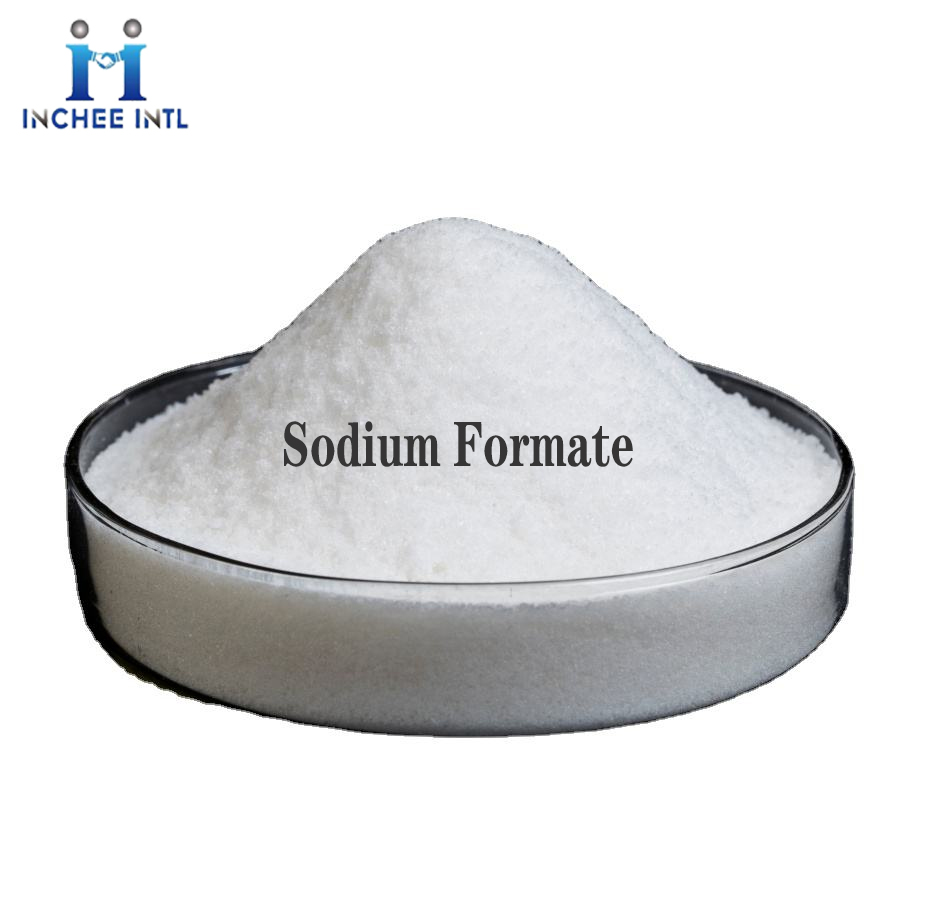
Sodium formate, also known as sodium methanoate, is the sodium salt of formic acid and the simplest organic carboxylate. Its core physical and chemical parameters are as follows: CAS No.: 141-53-7, molecular formula: HCOONa, molecular weight: 68.01. At room temperature, it appears as white crystals or granular powder with a slight formic acid odor and strong hygroscopicity and deliquescence. Anhydrous sodium formate has a melting point of 253-262℃. It is easily soluble in water and glycerol, slightly soluble in ethanol, and insoluble in ether. Its aqueous solution is nearly neutral with a pH value of about 7. It will decompose into sodium oxalate and hydrogen at high temperatures, and finally generate sodium carbonate.
Q2: Does sodium formate have anhydrous and dihydrate types? What are the differences between them?
Anhydrous sodium formate is a pure product with extremely low moisture content and higher stability, suitable for high-temperature and high-precision industrial synthesis scenarios. Dihydrate sodium formate contains two crystal water molecules, which is a common commercial form on the market with a faster deliquescence rate. Both types have consistent core chemical properties. The main differences lie in moisture content, melting point and application scenarios. Dihydrate sodium formate is mostly used in conventional industrial scenarios such as leather processing and concrete additives, while anhydrous sodium formate is applied in high-end fields including fine chemical industry and pharmaceutical intermediate synthesis.
Q3: Is sodium formate aqueous solution acidic or alkaline?
Solid sodium formate has no acidity or alkalinity. When dissolved in water, the formate ion undergoes slight hydrolysis, making the aqueous solution nearly neutral with a stable pH value of about 7. As neither strong acid nor strong base salt, it has good buffering performance, which can be used for pH calibration of strong acids and adapt to various production processes requiring stable pH value.
Q4: What are the mainstream specifications of sodium formate on the market? What are the core quality standards?
Sodium formate on the market is mainly divided into industrial grade and feed grade, both uniformly packed in 25kg bags. Industrial superior grade is the mainstream general specification, with core indicators: purity ≥98%, moisture ≤0.5%, trace heavy metal content and water-soluble impurity-free. Feed grade sodium formate also has a purity of over 98%, with stricter standards for heavy metals and harmful impurities, meeting the safety standards for feed additives without toxic residues.
Q5: What are the core application scenarios of sodium formate?
Sodium formate is widely used in multiple fields including industry, building materials, feed and fine chemical industry. 1. Chemical synthesis: As a core intermediate, it is used to produce basic chemical raw materials such as formic acid, oxalic acid and sodium dithionite, as well as for precious metal precipitation and metal complexation reactions. 2. Building materials industry: It serves as a concrete early-strength agent to accelerate cement setting, improve the early strength of concrete, and adapt to low-temperature construction scenarios. 3. Leather and printing & dyeing industry: It acts as a reducing agent and tanning auxiliary for leather tanning and dyeing processing, improving the color and texture of finished products. 4. Feed industry: It is legally used as a feed preservative and bacteriostatic agent to extend feed shelf life and inhibit the growth of harmful bacteria. 5. Other fields: It can be used as a pH buffer and mineral processing auxiliary for fine chemical and mineral processing processes.
Q6: Can sodium formate be used as a food additive?
No. Although sodium formate has preservative properties, it is only applicable to industrial and feed preservation, and is prohibited for food processing. Only a few EU countries allow its limited use, while the UK and China do not approve it as a food additive, and it is strictly forbidden to be illegally added to food products.
Q7: Why does sodium formate agglomerate easily? How to prevent agglomeration?
Sodium formate features strong hygroscopicity and deliquescence. It will quickly absorb moisture and agglomerate when exposed to humid air and high-temperature environments. This is a normal physical phenomenon and does not affect its inherent chemical properties. Prevention methods: Store in a cool, dry, ventilated and dark warehouse with ambient humidity below 60%, keeping away from water sources and heat sources. Keep the packaging completely sealed and never open for placement. Elevate the stacked goods to prevent moisture from the ground.
Q8: What is the conventional packaging of sodium formate? What are the transportation precautions?
The conventional specification is 25kg per bag with double-layer woven bag sealing packaging for moisture and leakage prevention. During transportation, the packaging must be kept intact and sealed to avoid damage, moisture and rain soaking. It is forbidden to transport together with strong acids, strong alkalis and strong oxidizing chemicals. The transport vehicle shall be dry and ventilated without high-temperature exposure. Handle with care during loading and unloading to prevent package breakage.
Q9: What is the shelf life of sodium formate? Can expired or damp products still be used?
The shelf life is 12 months under sealed, dry and normal temperature storage conditions. Slightly damp and agglomerated sodium formate can be crushed and reused in conventional industrial scenarios after passing purity detection. Seriously damp, hardened and expired products with decreased purity and excessive impurities are not recommended for use, so as to avoid affecting the quality of finished products.