




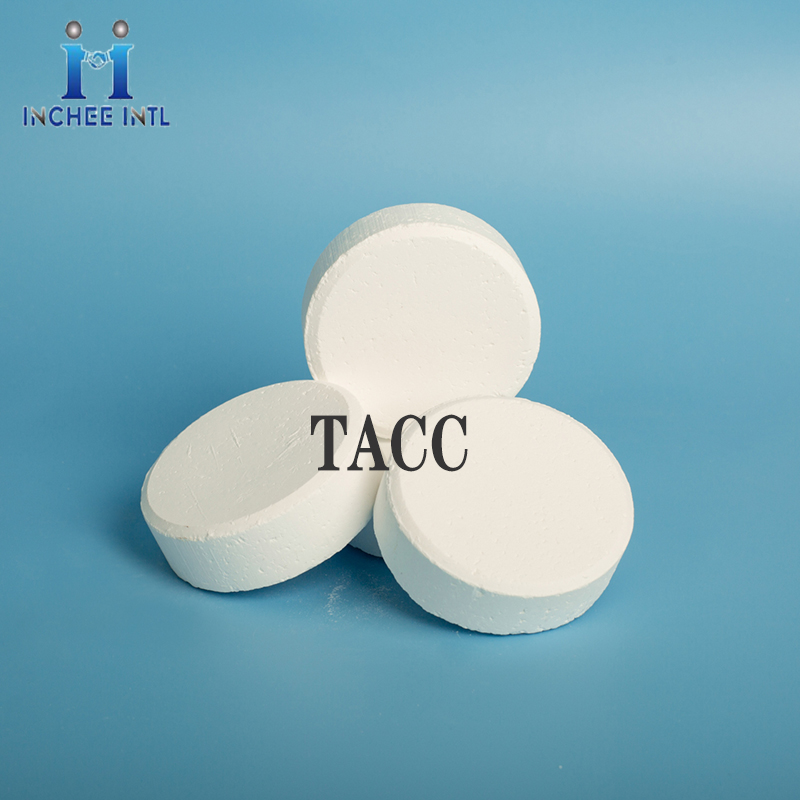
Manufacturer Good Price TACC CAS:87-90-1

Synonyms
1,3,5-Triazine-2,4,6-(1H,3H,5H)trione,1,3-dichloro,sodiumsalt;1,3,5-Triazine-2,4,6(1H,3H,5H)-trione,1,3-dichloro-,sodiumsalt;1-sodium-3,5-dichloro-1,3,5-triazine-2,4,6-trione;3,5-triChemicalbookazine-2,4,6(1h,3h,5h)-trione,1,3-dichloro-sodiumsalt;4,6(1h,3h,5h)-trione,1,3-dichloro-s-triazine-sodiumsalt;4,6(1h,3h,5h)-trione,dichloro-s-triazine-sodiumsalt;acl60;BasolanDC(BASF)
Applications of TACC
Trichloroisocyanuric ACID IS a high efficiency, low toxicity, broad spectrum, rapid sterilization disinfectant, which has the strongest bactericidal ability in chlorinated isocyanuric acid products, products can effectively and quickly kill all kinds of bacteria, fungi, spores, molds, vibrio cholera.
1. Disinfection of public places: it is mainly used for sterilization and disinfection of public places; Because of good algal killing, deodorization, water purification, bleaching effect, so can be used for swimming pool disinfection, drinking water disinfection, industrial water circulation treatment, food processing industry, food hygiene industry, aquaculture industry, daily chemical industry, medical and other places of disinfection. Meanwhile, the product can also be used in special fields such as Chemicalbook road cleaning and disinfection after disaster.
2. Disinfection of hospital personnel
The experiment showed that the application of trichloroisocyanuric acid in the clinical application of the hand disinfection of medical staff in the department of stomatology has achieved a certain effect. After the completion of the test, it was found that it had strong killing effect on Gram-negative bacteria and positive bacteria, especially Gram-positive bacteria, and no irritation to the skin, so it could be used for burn infection and skin disinfection.
3. Other uses
Trichloroisocyanuric acid can also be used as an anti-shrinkage agent for wool, chlorination of rubber, battery materials, organic synthesis industry and dry bleaching of clothing.



Specification of TACC
|
Compound |
Specification |
|
Appearance |
White table |
|
Available chlorine Wt. % |
90%MIN |
|
PH value (1% water solution) |
2.6-3.2 |
|
Moisture (%) |
0.5 %MAX |
|
Size /granular |
200g |
Packing of TACC


50kg/drum
Storage should be at cool, dry and ventilate.

Q1: What is sodium trichloroisocyanurate? What are its core characteristics?
Sodium trichloroisocyanurate (TCCA), commonly known as strong chlorine, is a high-efficiency and broad-spectrum organic chlorine disinfectant. It appears as white crystalline powder, granules or flakes with a slight pungent chlorine odor. Its available chlorine content reaches 85%-95%, featuring strong bactericidal power, sustained slow release, high stability, algae removal, deodorization, bleaching and bacteriostasis. It slowly releases hypochlorous acid when dissolved in water, continuously eliminating bacteria, viruses, fungi, spores and algae. With far higher disinfection efficiency than ordinary chlorine-containing disinfectants, it is a mainstream disinfection raw material widely used in industry, water treatment and aquaculture fields.
Q2: What is the difference between sodium trichloroisocyanurate and sodium dichloroisocyanurate?
Both are chlorine-containing disinfectants, but they differ greatly in available chlorine content, sterilization speed, duration of effect and application scenarios and cannot be substituted for each other. Sodium trichloroisocyanurate has higher available chlorine (85%-95%), good slow-release performance, longer efficacy duration and stronger stability, suitable for long-term disinfection, water body algae removal and large-scale water treatment. Sodium dichloroisocyanurate has lower available chlorine content, dissolves and takes effect quickly with short duration, which is applicable to rapid temporary disinfection and daily environmental sterilization. Sodium trichloroisocyanurate is the preferred choice for industrial long-term water treatment, swimming pools and aquaculture scenarios.
Q3: What is the sterilization principle of sodium trichloroisocyanurate?
The product undergoes hydrolysis when dissolved in water and continuously releases strongly oxidizing hypochlorous acid. It kills various bacteria, viruses, fungi, spores, molds and algae rapidly by penetrating microbial cell walls, destroying bacterial proteins and enzyme systems, and blocking microbial metabolism and DNA synthesis. Meanwhile, it can oxidize and decompose organic impurities in water and remove peculiar smells, achieving multiple effects of disinfection, algae removal, water purification and deodorization.
Q4: What are the common forms of sodium trichloroisocyanurate and their applicable scenarios?
There are three mainstream forms on the market: powder, granule and slow-release tablet, with clear application distinctions:
1. Powder type: Fast dissolution and strong permeability, suitable for whole-pond spraying in aquaculture, environmental spray disinfection and emergency sterilization and algae removal for sewage;
2. Granule type: Uniform dispersion, non-floating and good sinking performance, suitable for bottom disinfection in aquaculture and regular dosing for industrial circulating water;
3. Slow-release tablet type: Slow dissolution and long-lasting efficacy without frequent replenishment, mainly used for long-term bacteriostasis and algae removal in swimming pool water maintenance, landscape water and long-term water storage systems, labor-saving and efficient.
Q5: What is the difference between high-content and ordinary-content strong chlorine?
High-quality national standard sodium trichloroisocyanurate has an available chlorine content of ≥90%, featuring high purity, few impurities, stable disinfection performance and no residual sediment with outstanding long-term bacteriostatic effect. Low-quality products with insufficient available chlorine and excessive impurities have weak and short-lasting disinfection effects, which easily cause water turbidity and sediment accumulation at the bottom. They not only fail to meet disinfection standards but also bring risks of secondary water pollution. High-content national standard products are recommended for commercial engineering, aquaculture and swimming pool scenarios.
Q6: What are the main industry application scenarios of sodium trichloroisocyanurate?
1. Swimming pool and landscape water treatment: Water sterilization, algae and moss removal, odor elimination, maintaining clear and stable water quality and qualified residual chlorine in swimming pools;
2. Aquaculture: Water disinfection for fish, shrimp, crab and shellfish breeding, preventing bacterial diseases such as gill rot, skin redness and hemorrhage, and improving aquaculture water environment;
3. Industrial water treatment: Sterilization and algae removal for industrial circulating water, cooling water and reclaimed water, preventing pipeline algae sludge growth, equipment blockage and water odor deterioration;
4. Public environmental disinfection: Sterilization and bacteriostasis for floors, equipment and air in factories, venues and public areas;
5. Textile and papermaking bleaching: Used for bleaching and decolorization of fabrics and pulp to remove miscellaneous colors and improve whiteness;
6. Fruit, vegetable and warehousing disinfection: Compliant for site and equipment disinfection to inhibit mold growth and maintain the cleanliness of warehousing and fresh-keeping environment.
Q7: Can it be used for drinking water disinfection?
Qualified food and drinking water grade products can be used for secondary disinfection of domestic drinking water and pipe network bacteriostasis. Industrial-grade products are strictly prohibited for direct use in drinking water, food contact and food processing scenarios. Industrial-grade products are sufficient for ordinary commercial industry, aquaculture and swimming pool use. Only qualified drinking water-grade raw materials are allowed for drinking water scenarios with strict control of dosage and residual chlorine indicators.
Q8: What is the correct usage method of sodium trichloroisocyanurate?
1. Water body dosing: Tablets and granules can be evenly sprinkled directly; powder is recommended to be fully dissolved and filtered with water before sprinkling to avoid excessive local concentration;
2. Environmental disinfection: Dilute with water for spraying, wiping and soaking, then ventilate or rinse with clean water after a certain action time;
3. Regular maintenance: Adopt small-dose and multiple dosing for water body maintenance to stabilize residual chlorine and avoid water quality fluctuation;
4. Avoid high temperature periods: For aquaculture and outdoor water bodies, dosing is recommended in the morning and evening to reduce volatilization and improve drug efficacy utilization.


