
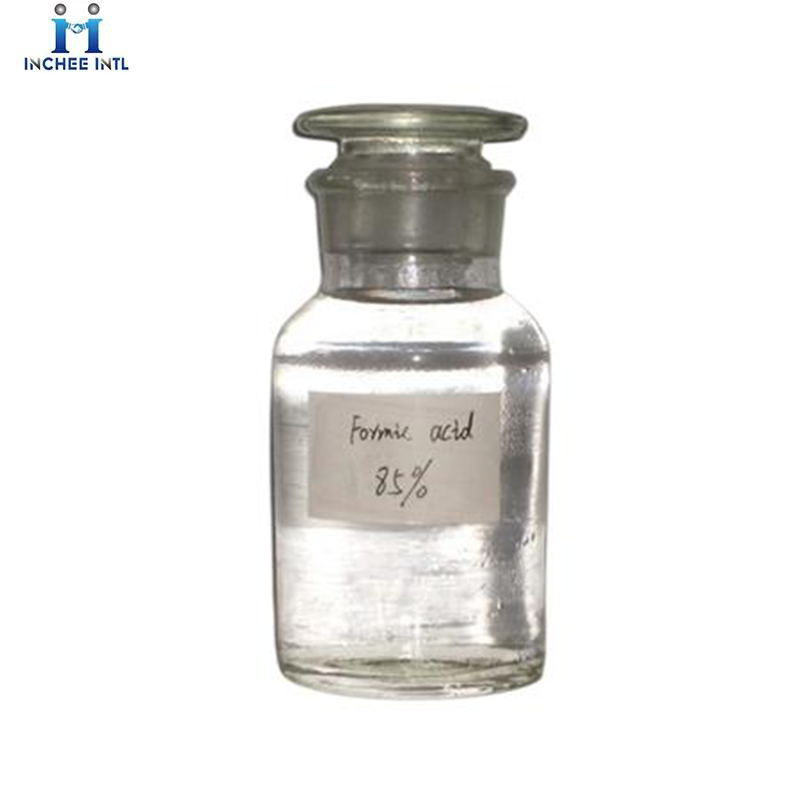
Manufacturer Good Price FORMIC ACID 85% CAS: 64-18-6

Applications of FORMIC ACID 85%
1.Formic acid has a number of commercial uses. It is used in the leather industry to degreaseand remove hair from hides and as an ingredient in tanning formulations. It is used as alatex coagulant in natural rubber production. Formic acid and its formulations are used aspreservatives of silage. It is especially valued in Europe where laws require the use of naturalantibacterial agents rather than synthetic antibiotics. Silage is fermented grass and crops thatare stored in silos and used for winter feed. Silage is produced during anaerobic fermentationwhen bacteria produce acids that lower the pH, preventing further bacterial action. Acetic acidand lactic acid are the desired acids during silage fermentation. Formic acid is used in silageprocessing to reduce undesirable bacteria and mold growth. Formic acid reduces Clostridiabacteria that would produce butyric acid causing spoilage. In addition to preventing silagespoilage, formic acid helps preserve protein content, improves compaction, and preservessugar content. Formic acid is used as a miticide by beekeepers.
2.Formic Acid is a flavoring substance that is liquid and colorless, and possesses a pungent odor. it is miscible in water, alcohol, ether, and glycerin, and is obtained by chemical synthesis or oxidation of methanol or formaldehyde.
3.Formic acid occurs in the stings of ants andbees. It is used in the manufacture of estersand salts, dyeing and finishing of textiles andpapers, electroplating, treatment of leather,and coagulating rubber latex, and also as areducing agent.
Specification of FORMIC ACID 85%
|
Compound |
Specification |
|
Appearance |
Colorless & Transparent liquid |
|
FORMICACID,%≥ |
85 |
|
CHLORIDE(AS CL_),% ≤ |
0.006 |
|
SULPHATE(AS SO42_),% ≤ |
0.006 |
|
TRON(AS FE3+),% ≤ |
0.0001 |
|
EVAPORATION RESIDUE,% ≤ |
0.060 |
Packing of FORMIC ACID 85%
1200kg/drum
Storage: Preserve in well-closed, light-resistant, and protect from moisture.


Our Advantages
FAQ
Q1: What are the basic specifications of Formic Acid?
A:
- Chemical Name: Formic Acid / Methanoic Acid
- CAS No.: 64-18-6
- Molecular Formula: $$CH_2O_2$$
- Appearance: Colorless, transparent and fuming liquid with a pungent irritating odor
- Solubility: Fully miscible with water, ethanol and ether, strong corrosivity and reducibility
- Main Grades: 85%, 90%, 94%, 99% industrial grade
- Key Index: High purity, low impurity content, stable chemical properties
Q2: What are other names of Formic Acid?
A:
Methanoic Acid, Hydrogen Carboxylic Acid. It is commonly known as Formic Acid in industrial trade, which is the simplest carboxylic acid in chemical industry.
Q3: What are the main applications of Formic Acid?
A:
1. Leather Industry (Core Usage): Used as tanning agent, deashing agent and neutralizing agent for leather processing, which softens leather, improves leather texture and reduces production cost.
2. Textile & Dyeing Industry: Acidifier and dyeing auxiliary for fabric dyeing and printing, stabilizing dye color and improving dyeing uniformity.
3. Chemical Synthesis: Raw material for manufacturing formate salts, pesticides, rubber antioxidants and various fine chemical products, also used as chemical reducing agent.
4. Animal Feed Industry: Feed preservative, acidifier and bacteriostat, inhibiting harmful bacteria growth and prolonging feed shelf life.
5. Oil & Mineral Processing: Used for ore flotation and metal surface cleaning and rust removal.
Q4: What is the difference between different concentrations of Formic Acid (85%/90%/94%/99%)?
A:
1. 85% Formic Acid: The most conventional and cost-effective grade, widely used in leather tanning, common textile dyeing and general industrial cleaning, suitable for most ordinary industrial scenarios.
2. 90% & 94% Formic Acid: Higher purity with lower water content, ideal for fine chemical synthesis, high-standard feed additives and precision textile processing, with better reaction activity.
3. 99% Anhydrous Formic Acid: Ultra-high purity grade, specially used for high-end fine chemical production, pharmaceutical intermediate synthesis and special industrial reactions, with strict impurity control.
Q5: What are the storage requirements?
A:
1. Store in cool, dry, shaded and well-ventilated professional chemical warehouse, keep ambient temperature below 30℃, avoid direct sunlight and high temperature heating.
2. Strictly keep away from strong oxidants, strong bases, alkaline metals and combustible substances to prevent violent chemical reactions, decomposition and explosion risks.
3. Use acid-resistant plastic or stainless steel sealed containers for storage, prohibit iron and metal containers. Original sealed shelf life is 12 months; keep tightly sealed after opening to prevent volatilization and concentration reduction.
Q6: What is the transportation classification?
A:
UN1779, Class 8 Corrosive Hazardous Goods, HS Code: 29151100. It belongs to dangerous goods for transportation. Export shipment requires complete MSDS, dangerous goods certificate and inspection documents. It must be transported by certified corrosive dangerous goods vehicles, forbidden to mix with oxidants, alkalis, food and daily chemicals.
Q7: What is the typical dosage reference?
A:
- Leather tanning industry: 10–30kg per ton of raw leather, adjusted according to leather thickness and softness requirements;
- Textile dyeing auxiliary: 0.5%–2% addition ratio in dye bath, to adjust system pH value;
- Feed preservation: 1–3kg per ton of feed, for mildew and bacteria prevention;
- Industrial chemical reaction: Dosage depends on specific synthesis process and experimental formula.
Q8: Can slightly discolored Formic Acid be used normally?
A:
Slight faint yellow discoloration caused by long-term storage does not affect conventional industrial use such as leather processing and ordinary cleaning. If the product turns dark yellow or brown, accompanied by obvious peculiar smell and increased impurities, it indicates deterioration, which will affect reaction efficiency and product quality, and is prohibited from use, especially for fine chemical and feed grade production.