



-

UOP GB-238 Absorbent
Description
UOP GB-238 absorbent is a specialty spherical absorbent designed to absorb arsine and phosphine from hydrocarbons.
-
Manufacturer Good Price Dimethyl Sulfoxide (DMSO) CAS 67-68-5
Dimethyl sulfoxide (referred to as DMSO) is a sulfur-containing organic compound, the English Dimethylsulfoxide, the molecular formula is (CH3) 2SO, is a colorless, odorless and transparent liquid at room temperature, a hygroscopic flammable liquid, and has both high polarity. , high boiling point, aprotic, miscible with water, extremely low toxicity, good thermal stability, immiscible with alkanes, soluble in most organic substances such as water, ethanol, propanol, ether, benzene and chloroform, known as For the “universal solvent”.
CAS: 67-68-5
-
Manufacturer Good Price Diethyl Toluene Diamine( DETDA) CAS: 68479-98-1
Diethyl Toluene Diamine( DETDA) is light yellow to amber transparent liquid. Diethyl Toluene Diamine( DETDA) is an excellent and low cost chain extender for elastomeric polyurethanes (PU) and also a curing agent for epoxides (EP). In addition Diethyl Toluene Diamine( DETDA) may be used as an intermediate for organic syntheses.
CAS: 68479-98-1
-

UOP GB-222 Adsorbent
Description
UOP GB-222 adsorbent is a high capacity spherical metal oxide adsorbent designed to remove sulfur compounds. Features and benefits include:
- Maximized active component for higher capacity compared to previous generations
- High surface area substrate to optimize dispersion of the active metal oxide to extend bed life.
- Customized active metal oxide for ultra-low level impurity removal.
- High degree of macro-porosity and pore size distribution for rapid adsorption and short mass transfer zone.
-

Manufacturer Good Price Polyetheramine T403 CAS:9046-10-0
Polyetheramine T403 is a class of polyolefin compounds with a soft polyether backbone, capped by primary or secondary amine groups. Because the main chain of the molecule is a soft polyether chain, and the hydrogen on the terminal of polyether amine is more active than the hydrogen on the terminal hydroxyl group of polyether, therefore, Polyetheramine can be a good substitute for polyether in some material processes, and can improve the application performance of new materials. Polyetheramine are widely used in polyurethane reactive injection molding materials, polyurea spraying, epoxy resin curing agents and gasoline scavengers.
CAS: 9046-10-0
-
Manufacturer Good Price DMTDA CAS:106264-79-3
DMTDA is a new type of polyurethane elastomer curing cross-linking agent, DMTDA are mainly two isomers, 2,4- and 2,6-dimethylthiotoluenediamine mixture (the ratio is about Chemicalbook77~80/17 ~20), compared with the commonly used MOCA, DMTDA is a liquid with lower viscosity at room temperature, DMTDA can be suitable for construction operations at low temperature and has the advantages of low chemical equivalent.
CAS: 106264-79-3
-

Manufacturer Good Price Methylene Chloride CAS:75-09-2
Methylene Chloride is a compound generated by two hydrogen atoms in methane molecules, and molecular CH2CL2.Methylene Chloride is colorless, transparent, heavier, and volatile liquid. It has a smell and sweetness similar to ether. It does not burn. Methylene Chloride is slightly soluble in water, and it dissolves with most commonly used organic solvents. It can also be dissolved in any proportion with other chlorine-containing solvents, ether, ethanol, and N-di metamimamamide. Methylene Chloride is difficult to dissolve in liquid ammonia at room temperature, which can be quickly dissolved in phenol, aldehyde, ketone, triathrin, tororine, cycamine, acetylcetate. The phase Chemicalbook is 1.3266 (20/4 ° C). The melting point -95.1 ° C. Boiling point 40 ° C. Fully low -boiling point solvents are often used to replace flammable petroleum ether, ether, etc., and can be used as local anesthesia, refrigerant and fire extinguishing agent. The spontaneous combustion point is 640 ° C. Decoction (20 ° C) 0.43MPa · s. The refractive index nd (20 ° C) 1.4244. Critical temperature is 237 ° C, and critical pressure is 6.0795MPa. HCL and traces of light are generated after thermal solution, and the water is heated for a long time to generate formaldehyde and HCL. Further chloride, CHCL3 and CCL4 can be obtained.
CAS: 75-09-2
-
Manufacturer Good Price Alpha Methyl Styrene CAS 98-83-9
2-Phenyl-1-propene, also known as Alpha Methyl Styrene (abbreviated as a-MS or AMS) or phenylisopropene, is a by-product of the production of phenol and acetone by the cumene method, generally a by-product of phenol per ton 0.045t α-MS.Alpha Methyl Styren is a colorless liquid with a pungent odor. The molecule contains a benzene ring and an alkenyl substituent on the benzene ring.Alpha Methyl Styren is prone to polymerization when heated. Alpha Methyl Styren can be used in the production of coatings, plasticizers, and as a solvent in organic.
Alpha Methyl Styrene is a colorless liquid. Insoluble in water and less dense than water. Flash point 115°F. May be mildly toxic by ingestion, inhalation and skin absorption. Vapors may be narcotic by inhalation. Used as a solvent and to make other chemicals.
CAS: 98-83-9
-
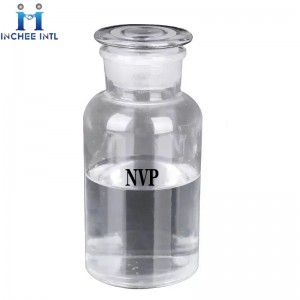
Manufacturer Good Price N-VINYL PYRROLIDONE (NVP) CAS 88-12-0
N-VINYL PYRROLIDONE (N-Vinyl-2-pyrrolidone) is referred to as NVP, also known as 1-vinyl-2-pyrrolidone, N-VINYL PYRROLIDONE. N-VINYL PYRROLIDONE is a colorless or light yellow transparent liquid with slight odor at room temperature, easily soluble in Chemicalbook water and other organic solvents. Because N-vinylpyrrolidone can increase various physical and chemical properties of products.N-VINYL PYRROLIDONE is widely used: in radiation medicine, wood floor industry, paper or cardboard industry, packaging materials, screen ink industry, the use of NVP improves the physical properties of products.
N-VINYL PYRROLIDONE (NVP) is commonly used as a reactive diluent for radiation curing in UV-coating, UV-inks, and UV adhesives. It is used as a monomer to produce water soluble polyvinylpyrrolidone (PVP) with uses in pharmaceuticals, oil field, cosmetics, food additives & adhesives. It is used in the manufacture of copolymers with, for example, acrylic acid, acrylates, vinyl acetate and acrylonitrile and in the synthesis of phenolic resins.
CAS: 88-12-0
-

Manufacturer Good Price P-TOLUENESULFONYLISOCYANATE (PTSI) CAS 4083-64-1
P-TOLUENESULFONYLISOCYANATE (PTSI) is a single functional isocyanate. P-TOLUENESULFONYLISOCYANATE (PTSI) has high activity and can react with conventional diisocyanates, such as TDI and HDI, with water in polyols and solvents. The resulting carbamate does not increase the viscosity of the system. The disadvantage is that the toxicity of oxazolidine and other dehydrants is large; P-TOLUENESULFONYLISOCYANATE (PTSI) reacts with water to produce carbon dioxide and toluenesulfamide, so P-TOLUENESULFONYLISOCYANATE (PTSI) cannot be used directly in paint formulations and is generally used for pre-dehydration. To remove 1g of water in the solvent, about 12g of PTSI is theoretically required, but the actual amount should be higher than this.
CAS: 4083-64-1
